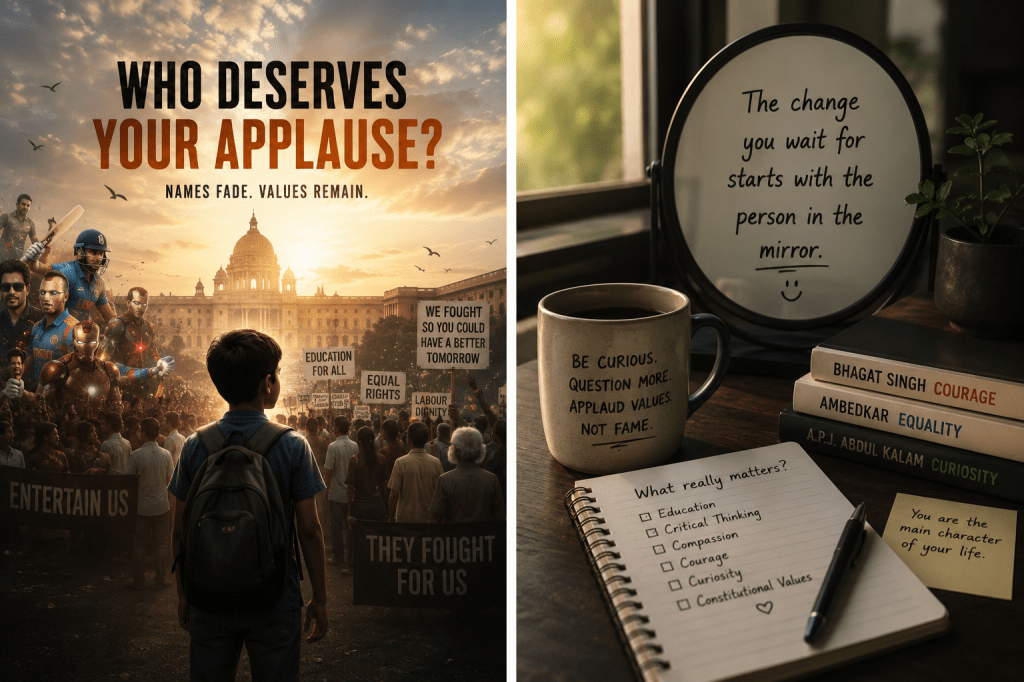
I know when the next Marvel movie releases. I used to know the batting average of my favourite cricketer. I can recognise actors, athletes and influencers almost instantly. But ask me to name the people who fought for my weekends.
I might remember a few..And after that— Silence.
Many of the comforts we casually enjoy today came at a price someone else was willing to pay.
- The five-day work week.
- Paid leave.
- Labour rights.
- Education.
None of these appeared because society suddenly became kind. They exist because ordinary people challenged extraordinary systems. Not for applause. Not for fame. But because they believed future generations deserved better.
Somewhere along the way, we’ve become remarkably good at remembering personalities. But remarkably poor at remembering principles.
We celebrate heroes. Yet rarely practise what made them heroic.That, perhaps, is the greatest irony of all.
And perhaps that’s where we lost something important. Somewhere along the journey, we stopped admiring values and started worshipping personalities. Every major issue is followed by the same question:
“Why haven’t the actors spoken?”
“Why hasn’t the cricketer posted anything?”
Maybe we’re asking the wrong people.
Not because artists or athletes shouldn’t have opinions—they absolutely can. But because somewhere along the journey, we handed them responsibilities that belong to us.
Democracy isn’t something performed by celebrities while the rest of us watch from the stands. It survives because ordinary people choose to participate. The irony isn’t that celebrities remain silent.The irony is that millions of voices wait for their permission before speaking. Technology has made this contradiction even sharper. Artificial Intelligence can answer almost any question within seconds. But there’s one thing it cannot do for us.
It cannot decide which questions are worth asking.
Finding answers has become easier than ever. Developing curiosity has not. Critical thinking still has to be learned. Education still matters. Not because it helps us score marks. But because it teaches us to separate popularity from importance. To distinguish noise from substance. To question without hatred. To disagree without losing our humanity.
Which brings me to why I’m writing this today. Today, for me, that example happens to be Sonam Wangchuk. Tomorrow it could be someone else. The individual matters less than the principle.
Whether history ultimately agrees with today’s movements is something only time can decide. What interests me is something else. What kind of society are we becoming when entertainment captures our attention faster than education?
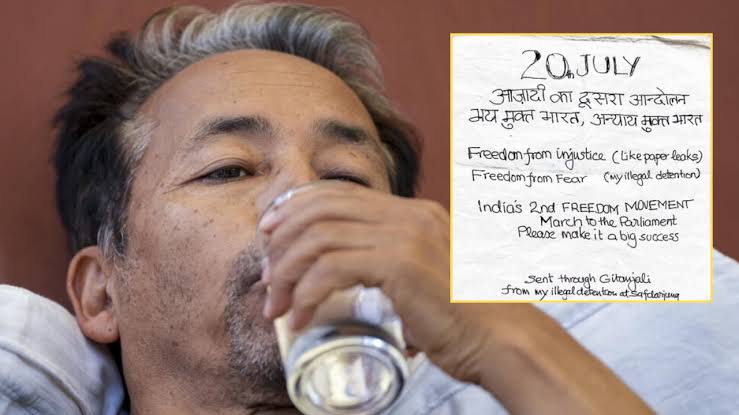
When someone chooses peaceful protest, risks personal comfort, and places their own body at the centre of a cause, it usually tells us something important. It tells us that, in their eyes, the issue is bigger than themselves. History will eventually decide how today’s movements are remembered.
But a meaningful change has never begun with applause. It has always begun with awareness.
One day, I hope we stop waiting for heroes. We’ll realise the main character was never on the cinema screen. It was the person looking back at us from the mirror.
Because the question was never,
“Who deserves my applause?”
The question has always been,
“Who deserves my attention?”
And perhaps…
the answer begins with the person staring back at us.